Session Five: The Lever
October 17, 2014
We had begun to feel pretty good about ourselves so we asked Ben for a harder question. He obliged with the classic Trolley Dilemma, first posed by British philosopher Philippa Foot. We talked it through for more than an hour, sitting once again in the comfortable little library at Elsewhere. So in the end were we strict utilitarians or were there other ethics at work ? This meeting of the Philosophers’ Club was held in mid-October, two months after Michael Brown was killed in Ferguson, Missouri, and the discussion turned to our varied experiences of being black and being white in America.
So should you pull the lever? John Stuart Mill and Emanuel Kant say yes. Walter and Liz aren’t so sure….
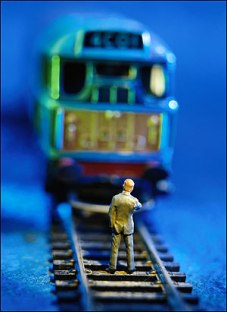
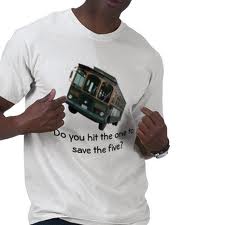
Ben’s Question: Imagine a trolley is flying down a busy street in San Francisco—its brakes have malfuncti oned and it is about to run over three unaware bystanders. In front of you is a lever that will cause the trolley to switch tracks and go to a quieter street where it will only run over one person. Would you pull the lever?
Walter: I would have to pull the lever.
Liz: So it’s nobody’s fault, but as soon as you pull the lever you’re the one who has decided that that person will die.
Walter: That’s one way of looking at it. But then if you do nothing……oof.
Liz: There’s more. Now imagine that the three people are teenagers and the one person is an elderly lady—does that change your decision?
Walter: The three people are teenagers? Can I warn them?
Liz: Can’t warn them. It’s all happening too fast.
Walter: Ooh, that’s a tough one. I wouldn’t pull the lever. Because the teenagers have a better chance of moving off the track, where the elderly person may not be so agile. So I would let it go and hope for a best.
Liz: Now more. What if the one person were a family member while the other three were total strangers?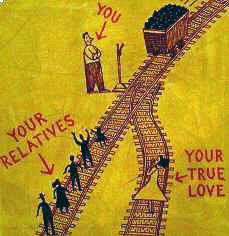
Walter: Same age group? And I can’t open my mouth? On the one hand I can pull the lever and maybe my family members would understand, but on the other hand if I don’t pull the lever I’m being selfish. Hmmm.
Liz: People make decisions like that all the time. So how would you make that decision–this person has to die in order to save that person?
Walter: Oof… I wish it was me in place of one of the people.
Liz: The trolley is headed for the three people and you pull the lever and the other person is killed by the trolley, did you kill that person? Are you responsible for that person’s death?
Walter: I would think that maybe I am. The trolley is already out of control but I’m guiding the missile. Hmm. Yes, I would easily say yes, it would be me killing the person.
 Liz: So if you choose to run over the old lady does that imply that one life has more value than another? So you’re saying these are three young people who have their whole lives ahead of them and here’s an old woman. She’s lived a long life so she can go. You know, in the medical profession people have to make those decisions all the time. There are only so many kidneys to go around, for instance. How do you evaluate who gets the limited number of kidneys, knowing that the people who don’t get the kidneys are going to die?
Walter: That’s a question that you really can’t get right and you can’t get wrong. I can say that some people have their whole life ahead of them and if they don’t get the kidney they lose that opportunity, and I can say this person is sicker and deserves some relief.
Liz: So let’s say you’ve got a whole bunch of file folders in front of you, files on people, and all of them will die in the next couple of months if they don’t get a kidney. One is a young person, one is an older person and one is a very old person. The young person has already been convicted of a couple of crimes, some of them violent. The next person has gone to school, has lots of degrees, has a good job and maybe has the potential to, I don’t know, invent something that would benefit a lot of people. The old person is much much loved by a lot of people and has had a distinguished career. So you’ve got the 19-year-old criminal, the 55-year-old successful scientist, and the grandparent with a big family.
Walter: For me it would boil down to the young criminal or the middle-aged success story.
Liz: The old person is off the table.
Walter: Off the table. They’ve already lived a good life. I’m satisfied with that.
Liz: Based on the young person’s legal history it’s entirely likely that person is going to commit another crime. Legally he hasn’t gotten the death penalty, but without a kidney he’ll die.
Walter: So it’s a gamble.
Liz: Would there be any objective way to decide that one person’s life has more value than the other person’s life?
Walter: You’d have to meet with the two people.
 Liz: And then would you feel good about making the decision? About saying “I didn’t really like him, he’s got to go”?
Walter: You know, it wouldn’t be a matter of whether I liked him or not. It would be a matter of what good they could do for society.
Liz: And could you trust yourself to be completely objective?
Walter: I could, yes.
Liz: Could you trust everybody to be completely objective?
Walter: No.
Liz: So the moment the lever becomes available to us…..It’s one thing if you’re just in the trolley and there is no lever, but the moment there becomes free will, you have a choice,  you’re taking on some responsibility. Does that make you more like God?
Walter: Um, no.
Liz: No?
Walter. No. Because I have the choice to pull the lever or not? No, I don’t think so.
Liz: But you have chosen to save one person and let the other person die.
Walter: But if I don’t pull the lever I didn’t make that choice. I made the choice not to act, yes, OK, but I don’t think that put me in a position of God. I think I’m in a position of human instinct or human error.
Liz: I know for myself there are days and moments when if all somebody knew about me was that moment they wouldn’t necessarily have a very good opinion of me. Have there ever been periods in your life where if that were your entire life….
Walter: Oh yeah. In my teens when I was with a crowd that you might say was not quite sociable. People could judge me my the crowd I was with without really getting to know me as a person.
Liz: So if the trolley was speeding towards you at that moment….?
Walter: They would have let it go, they would have run me right over. They would have sped it up probably!
Liz: What were you guys doing?
Walter: I can’t distinctly remember, but I know it wasn’t good. Scratched up somebody’s car, threw eggs at it. Vandalism.
Liz: You’ve said that there was a period in your life when you lost a lot of relationships and made a lot of mistakes. Were you essentially being faced with some of these choices–what is the right thing to do in this situation?
Walter: You know, that’s one of thing I was angry at God about, and I still kind of feel that way. When you’re young, really young, you really don’t know, and then when you grow older you wonder why you did those things. So I kind of felt angry at God because I felt as though in some miraculous way he should have instilled in us the knowledge that this is what’s going to happen if you do this, you know. If I had not committed some of the crimes that I did….
Liz: So you feel as though free will is given to us too young?
Walter: Pretty much.
Liz: So going back to the trolley for a moment, there’s always going to be a choice, even in the way you operate a society. Every choice we make has a consequence. Every act we perform has a consequence. Say you’re running a homeless shelter and every bed is full; if you let more people in it will be dangerously crowded, so you make a decision that no matter what, the next person who comes to the door, no matter who that person is, no matter what 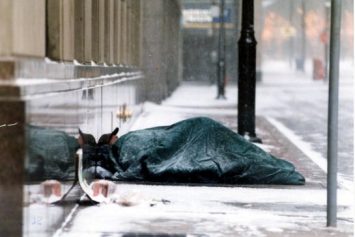 their circumstances, no matter what the weather’s like, that person can not come in.
Walter: And then here comes your brother….
Liz: Here comes your brother, here comes an old lady with three grandkids. Where do you draw the line? And how do you choose in your own life where the line is?
Walter: I think one of the biggest problems is that we make it softer on ourselves by using the term “collateral damage”. We fill our shelters up with homeless people and the rest are collateral damage. I think that’s God’s way of letting mankind know that we really can’t govern ourselves. If we could govern ourselves we wouldn’t have a homeless population. If we could really govern ourselves as human beings.
Liz: So does that mean “don’t touch the lever” because God put the trolley in motion?
Walter: No, I think the malfunctioning of the trolley was an imperfection of mankind.
Liz: Have you ever heard the parable about the man on the beach throwing starfish back into the water to save them? Somebody pointed out to me that starfish consume clams, so the more starfish you put in the water the more clams will get eaten. Over its lifetime a  starfish might eat thousands of clams, so by choosing to throw the starfish back in the water you’re choosing the starfish’s welfare over the clam’s.
Walter: So it comes down to who likes starfish and who likes clams.
Liz: And who gets to decide. Is there a moral code you can come up with that would fit every situation. Sort of like the Ten Commandments. The Ten Commandments are supposed to fit every situation, right? But we say “Thou shalt not kill” and then we send armies out into the field and even sing “Onward Christian soldiers.” Can there ever be a one size fits all? Could there be a situation where someone would say “Here’s the lever in front of me, my choice is very clear. Because of my code of conduct I know what to do next?”
Walter: I think there is. I call it the truth.
Liz: But how do you know what the truth is?!
Walter: A lot of people say “You know when you know that you know.” I think through study and research you come to the point where you know when you know that you know.
Liz: So now if you’re the one standing on the street do you want to trust your future to hoping that somebody knows the right thing to do? Like “Black Lives Matter”–the number of young black men who get shot by police is way out of proportion, and particularly after what happened to Trayvon Martin and Michael Brown many people are saying we don’t value the lives of young black men the same way we value other people’s lives. So in th e same way on the trolley you’re saying “Well, she’s an old lady, she’s had a good life”–and there’s some logic to that because she’s had more time–to look at a young black man and see the hoodie, the dreads, and say “he must be a thug, he must be dangerous, he’s on drugs….” So a whole culture is on the speeding trolley and making snap decisions.
Walter: But a lot of that is brought on by the society of young black men themselves because they know, at least by now, that it doesn’t fit well with society to walk around with your belt right here and your pants hanging down loose. If I do that, and I know what society thinks of that, I’m inviting society to say I’m the typical stereotype you should look out for.
Liz: But somebody shouldn’t be shot dead because his pants are sagging!
Walter: They shouldn’t be, but if we know what the stereotype is we should stay away from that stereotype instead of being defiant.
Liz: Let me ask you this: did you do everything your parents told you to do?
Walter: Absolutely not.
Liz: Do you think your mother worried when you went out the door that somebody would think that your life didn’t have as much value as the next person’s?
Walter: Yes, I’m quite sure she did.
Liz: So was it your responsibility to change, your mother’s responsibility to change, or the whole society’s responsibility to change?
Walter: I feel as though it was my responsibility to change. But being as young as I was then–you know, you have to have the big Afro with the pick in the back 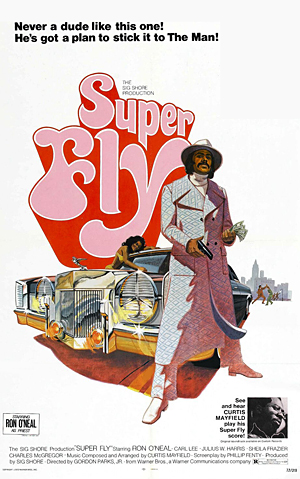 with the Black Power sign sticking out of the pick, and wear the platform shoes and the bell bottoms, double-knit pants, the big gold chain.
Liz: You dressed like that?? Do you have any pictures!?
Walter: No.
Liz: Super Fly?
Walter: Super Fly.
Liz: So you were expressing yourself, that was who you wanted to be right then, but that doesn’t mean that someone with his hand on the lever should say “There’s a kid over there with an Afro and a gold chain. I’m pulling the lever.”
Walter: That’s the way people would think.
Liz: But there’s a distinction between the way it is and the way it should be. If you’re creating a code of ethics, does that code include that anyone with an Afro and platform shoes is inherently less valuable?
Walter: It shouldn’t be. How a person dresses or how they do their hair…
Liz: I just can’t get that picture out of my mind now. Sorry.
Walter: If I’m creating a code of ethics then none of that should matter.
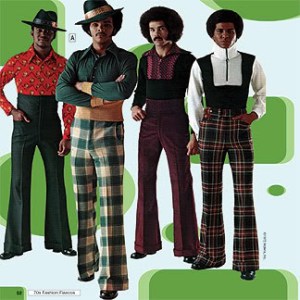 Liz: So you’ve got a guy over here, Afro, the chains, the platform shoes, the whole nine yards and you’ve got another guy over there, Afro, chains, shoes, the whole nine yards. Their appearance is the same, they’re just two young men that look like they went to the same school or something.
Walter: That’s easy: I would not pull the lever.
Liz: Would that be to relieve yourself of the guilt of the outcome? To leave yourself out of the equation?
Walter: Yes. I would not touch the lever, because if I do I’m killing somebody.
Liz: Interesting! So what you’re saying is that there’s a code of ethics that says that not acting is better than acting.
Walter: Yes.
Liz: So passively doing harm is better than actively trying to do good where you take the risk of failing.
Walter: I think I would feel better about not acting……one thing you didn’t mention, though–do I know that if I pull the lever it’s going to kill somebody?
Liz: That’s a very good question. So you pull the lever thinking you’ll just go into a quiet side street and once it’s too late there’s a guy standing there. I think any code of laws we can think of would recognize that. Anybody would say “With the information he had he was trying to save this guy’s life.”
Walter: I would feel a lot better then about pulling the lever because I was doing my best to save a life. I was doing my best.
Liz: I don’t know. I’m still not convinced it’s possible to create a code of ethics that covers everything, but there comes a moment where you just have to decide, acting or not acting is a decision. Maybe at that point you just do what you can.
Walter: So you can decide not to decide. Which is a decision.
Liz: You know, kind of embedded in what you were saying before with the kidney question, and even with the trolley question, you wanted to sit down and get to know someone before you decided, once we have a personal connection with someone maybe our decisions will change. So sometime we might say “I hate that guy, I wouldn’t help him if he were the last person on earth.” But if he were actually the last person on earth you two would probably get to know each other pretty well.
Walter: You definitely would need that person. And they would need you.
Liz: So there’s some value in people getting to know each other, in not making decisions based on superficial things. Going deeper. Which I guess is what the court system is all about, trying to have blind justice, not making decisions based on assuming that young black boys with giant Afros and platform shoes are nothing but trouble.
Walter: It was sure easier that way, wasn’t it? At least some people would think so–“It was the black guy with the big Afro! Just pick any one of them!” That is what happens and it’s a shame. It’s a terrible thing.
Liz: And I’ll bet even…I’ll bet even since you changed your hairstyle you’ve encountered that. Do you feel as though people stereotype you?
Walter: Oh yeah. Me and Tammy walking down the street, it’s a whole different ballgame. She may not see it, but I get more respect, even from white people, because I’m with Tammy. They look at me like “Oh, he must be something special.”
Liz: Pull the lever.
Walter: Pull the lever. Of course I’m not caucasian, so I don’t know what it’s like to be a white person to walk alone down the street.
Liz: It’s awesome.
Walter: Yes? I believe it. I bet shop owners even come out and say “Hey, come on in!”
Liz: Yep. I’m sorry to say that white privilege is kind of terrific. My privilege is not made greater because you don’t have it but I’m not going to pretend that when the cards are all stacked in my favor it doesn’t make life easier, because it does. Somebody pulled the lever a long way back and said “Let’s divert it down the side street and run over a whole bunch of other people and let her keep walking.”
Walter: There you go. They pulled the lever for you.
Liz: What were the ethics behind that?
Walter: To me it’s unfortunate that some people believe that certain race of people should be superior, more valuable in life. It’s unfortunate but it’s true. Human imperfection.
Liz: What that means is that we create a code of ethics where maybe somebody’s on the speeding trolley, the lever’s in front of them, they think they’re making an objective decision based on the two people they see at this fork in the road, but there’s a whole pressure of society behind them so when they’re making that snap decision they may say “That kid looks like trouble” and “That lady looks valuable.”
 Walter: Remember, I was kind of saying the same thing even in the black culture when I was young: the darker skin you were the further back in class you sat. That was an intentional distinction between us even in the black world. People automatically said “He’s a darker person so he’s not going to amount to much.”
Liz: This is just my opinion, but I think the distinction between skin tones in the black community wouldn’t exist if it weren’t for white people. If America were entirely black and there was no benefit to being white I don’t think the shades would matter.
Walter: I think always and in every society there are certain people who want to be on top, who want to be oohed and aahed by the populace.
Liz: If that’s just the human condition, if in any group people are going to sort themselves out into a hierarchy where some people have power and some people don’t, does that make it easier to make a rule about the speeding trolley? Can we just all agree that this person has more value than that person? Now the person who has no value may not be so on board with it, but is that just sort of the human condition, that we’re going to be on a speeding trolley having to make a choice and we’re always going to say….
Walter: I have to say, in this system of things it’s always going to be true.
Liz: So the best we can hope for is a consensus that a middle-aged white man in a suit with a briefcase is going to have more value than the kid with the Afro. Do we have to accept that?
 Walter: Do we have to accept that. Hmm. Hmm, no. Well no, personally no, we don’t have to accept it, but the populace, the majority of the people do accept it. They may not even think they accept it, but they do.
Liz: So do we as a culture and a community have an obligation to try to create a system that will be as fair to the kid with the Afro as it is to the man with the briefcase?
Walter: Well you know my belief system. I think it’s too little too late.
Liz: Wait, so you’re going to kick your former self to the curb and just say “Sucks to be you…”?
Walter: No, what I’m saying is the system has already been put in place and the only hope for mankind is the kingdom of God.
Liz: So in a perfect world the trolley would just speed along…
Walter: Not hit nobody. In fact it would probably go slow, because we would have all the time in the world.
Liz: And even if you got hit you wouldn’t die, right?
Walter: No, I think it’s that we would be so careful and so mindful of what was going on around us that we wouldn’t just idly stand around on the tracks to get hit in the first place.
Liz: That’s a nice thought. So we just hope for a perfect world?
Walter: And I believe it’s coming.
Liz: Can we a least try to make this world as much as possible reflect that world?
Walter: I think that we can. There are things even now. I believe the time will come when the whole earth will heal itself.
Liz: And no more speeding trolleys. And the starfish will lie down with the clam.
Walter: That’s it! That’s it.
 The Philosophers' Club
I’d keep my hands off the dang lever! I don’t know the any of the idiots who will disregard the large and loud ringing bell on a moving trolly…..walking aimlessly across a dangerous track that is well known in popular circles to kill. Has anyone ever heard the expression, “Stop, Look and Listen”. Even if I am deaf, I’ll look and even if I am blind, I’ll listen. Poop happens more to the careless and less to the cautious.
LikeLiked by 1 person