Session Four: Doing Time
Tuesday, October 7, 2014
The Philosophers’ Club met at a Mrs. Winner’s near Walter’s new home and spent an hour discussing the slippery, inconclusive nature of time. When it was all over we agreed that this was the hardest question yet.
Kris Schumacher
Time is the greatest mystery of life. It pervades our experience but somehow stands completely behind it. We mark clocks and attempt to compartmentalize time, counting the minutes and seconds as if time moved in a regular stream: but how different time feels! Hours can feel like minutes, while a second can stretch out into an eternity. Does time exist outside of our inner experience of it? How can time both dissolve and flow in irregular waves and still be counted in the ticks of a watch?
Walter: Wow.
Liz: Is time a real thing or is it all our perception?
Walter: I believe time became a real thing, but in the beginning there was no real concern or worry, or maybe even concept of time. It was just day for a while and then it’s night for a while, it’s time to wake and then it’s time to sleep, but then when the hustle and bustle started getting involved, working instead of bartering, when we started living by the standard of “hey can you do this for me in a certain amount of time” so now we feel obligated to wake up in the morning, set the alarm clock, get up and go to work. And have it all done before that day is over.
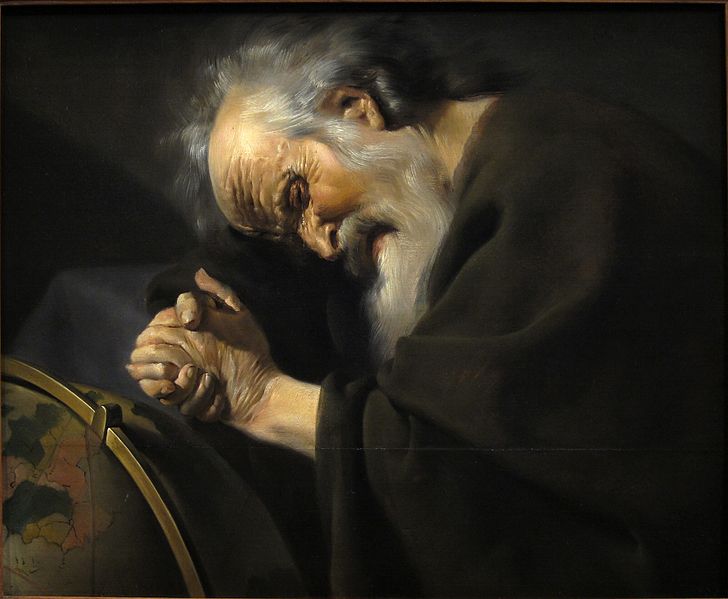
Heraclitus by Johannes Moreelse
Liz: The Greek philosopher Heraclitus said “No man steps in the same river twice.” Each time you put your foot in…..
Walter: …it’s a new body of water. It flows.
Liz: We use the word time in all sorts of figures of speech–“doing time” is an obvious one
Walter: Each day in prison or jail seems like an eternity.. When I was in there first I was counting day after day but that was too anticipating–the days became longer. So what I did in my mind was not think about the day, and wait for the month. “Another month gone, another month gone.” It was a little better but that was even taxing, so I looked for each holiday. Every time Christmas came around I would say “Well, that’s a Christmas gone. I won’t see that Christmas again.” Even though the same holiday comes next year it won’t be the same as the holiday I had in there the first year or the second year or the third year. When I had the fourth year of the holidays I thought “Wow, no more holidays in prison.” I knew I would not see another Christmas in prison and before the next Christmas I was out.
Liz: So where we might have a clock that was measuring things in minutes you had another clock that was measuring things basically in years.
Walter: I noticed that in between those holidays I–I wouldn’t say I had no concept, but I had no thought of time. It’s not time yet until the holidays come. The next hour doesn’t come until December 25.
Liz: How did you do that? That’s hard!
Walter: I really don’t know. I want to say by…..force? I felt like I had to do it because if I didn’t do it I would just go crazy.
Liz: How long were you in?
Walter: I was in for five years. I went in ‘99 and I actually got out in ‘03 but then I violated and went back and did two more years.
Liz: How long were you out before you violated?
Walter: Three or four months. I couldn’t understand the idea of being out of prison but now you’ve got this parole officer who comes by every week and then he wants you to pay him $70 a week. Pay you $70 to watch me? So I thought, instead of doing this I’d rather go back and do my time and get it over with, come out and no probation.https://www.youtube.com/watch?v=qlmUWMbBKI4
Liz: I know when I’ve been in a situation where I know something bad is going to happen but it hasn’t happened yet….
Walter: It comes fast.
Liz: It comes fast and it goes real slow. It’s like you’re aware of every minute. I can imagine that when you’re sitting in a courtroom waiting for a decision time is different than just walking down the street to buy a pack of cigarettes.
Walter: You know the thing is, I had gotten used to being in jail but I had never been to prison and I was scared to go. First they said I was going to CP—Central Prison. That’s the last place anyone would want to go for prison time.
Liz: How come?
Walter: That’s where death row is. I went to CP one time to get dental work done and it was true, you go in there and it’s just the smell of death. I actually saw the chamber where they take people in and execute them–it’s like this bubble you look through, like looking through a window on a door and you can see the bed, it’s like magnified, and the things that run through your mind—people actually lie on that slab to be done away with.
Liz: I wonder what that time is like.
Walter: You know, the people you meet that are on death row, they’re some of the calmest people you’ll ever meet. They really have a hold on what life should have been, what life should be like. They’re actually living it.
Liz: I wonder if you get to the point when you’re out of time, when you’re just waiting for your life to end, when you’re no longer saying “Just one more Christmas”, if time becomes different.
Walter: Well, I’ve never been on death row, but for myself, I would probably numb myself and with the strong belief I have in the Bible that would comfort me. But to know that at 3:00 this evening I’m going to be done away with, that’s a hard pill to swallow.
Liz: Other people who were in prison with you, were they experiencing time differently from the way you were?
Walter: There were a lot of people who really just cried the blues every day–they’re drawing calendars on the wall, 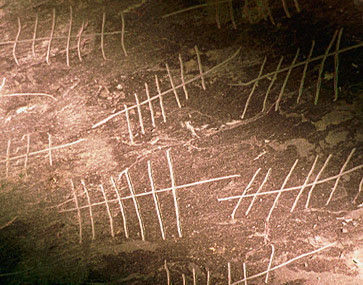 they’re marking the days. I tried that. You got to wait a whole 24 hours to mark a day and that makes it even worse. I can’t see it. If I see a calendar on the wall and it has 20 marks on it–I’ve got ten, eleven more marks to go. So twelve o’clock midnight you’d mark another….oh come on! That’s a waste of time.
Liz: There’s another one—”waste of time.”
Walter: Waste of time. And a stretch of time. That wouldn’t work for me.
Liz: In your documentary and then again in your song it comes up about your grandfather talking to you. That was one brief period of your life but it seems as though it has stretched out.
Walter: Because of the color of my skin. My grandfather was just as dark as I am but he didn’t favor me because of my skin tone.
Liz: Is that why he talked about your art too?
Walter: Oh yeah. “You’re never going to be nothing, you’re not going to make it. Learn to be a carpenter or a trash man.”
Liz: So a moment of your childhood is still with you but if you’re like me I’m sure there are plenty of other days you don’t remember.
Walter: I remember the extremely good times and the extremely bad times but in between may be a little foggy. I remember the day I crawled under the kitchen cabinet and started peeling potatoes. I would watch my grandmother and my mom in the kitchen cooking. My grandmother would sit in a chair peeling potatoes while watching wrestling on TV.
Liz: So that whole thing took maybe an hour…..
Walter: It was a good time.
Liz: And that hour has stretched out over 50 years. Given that, how is possible to build a clock that everyone can look at and say “Now it’s 3:00” and then “Now it’s 3:15” and those fifteen minutes are a fixed objective thing that’s the same for everybody?
Walter: We say “It’s ten o’clock”, but is it really ten o’clock?
Liz: That’s the question! “Does time exist outside of our inner experience of it? How can time both dissolve and flow in irregular waves and still be counted in the ticks of a watch?”
Walter: Does time exist outside of our realm of thinking? You know, I was thinking about how the government charges time on cell phones We get on the phone at 10:00 and at 10:15 our time is up, but the government said we had 250 minutes. That can be not so many minutes on the clock.
Liz: So time is made subjective. The government says we’re going to call this unit a minute, but this minute is different from that minute.
Walter: So it depends on the circumstances. Like we were talking about prison. Thirty days could mean thirty years to the person who’s going, and we’re out here saying “You only got thirty days? Don’t worry about it! I can do that standing on my head.” Easy for you to say, but you get put in the handcuffs and taken downtown and sit there for thirty days. It’ll be a whole different story. You know, people actually believe that God has designated certain times to do certain things in a certain place.
Liz: So it’s all predestination?
Walter: That’s what a lot of people believe. Even if someone got hit by a train other people will say “Well it was his time.” That really bothers me because, for one thing, they’re blaming bad things on God and I think that’s just a morbid way of thinking, to think that God has given us life just to take it. That wouldn’t make sense. The truth is that in the Bible it says that “time and unforeseen circumstances befall them all.” If I’m killed and you’re not it doesn’t mean that God wanted me dead and you not. It just happened.
Liz: And I guess if we could separate ourselves less from time death would have less meaning.
Walter: Right.
Liz: So is time different when you’re sitting there saying “When is this ever going to end” from “Why is this ending so quickly?”
Walter: If you’re doing something that you like to do that time becomes pleasurable and it just doesn’t last long enough. If I had a job going in and painting whatever I wanted to paint that’s enjoyable time for me and I wouldn’t be able to wait to go to work. I wouldn’t miss a day–I wouldn’t miss a minute. As opposed to flipping burgers.
Liz: Which means if you could find a way to love flipping burgers you would regain command over your time.
Walter: So I guess the key is to find a way to enjoy whatever you’re doing.
Liz: Can you do that in prison?
Walter: Actually, you can. Not enjoy the fact that you’re in prison but you can do other things.. A lot of people go to the gym, they exercise, they play basketball, they write books, draw and paint. It’s a matter of how you spend your time.
Liz: So the whole point of prison is doing is taking your time, taking you out of the path you were on for a period of time that you have no control over. Somebody else decides that you’re going to be gone for, say, six years. So prison is the sort of ultimate conundrum about time. What is time if somebody can take it away from somebody else? And then what you’re saying is your time isn’t actually completely taken away from you.
Walter: It’s a perception of the mind.
Liz: So prison was hardest for people who couldn’t make their peace with the fact that they were in prison?
Walter: A lot of people use the term “taking away their freedom.” You realize that you no longer have the freedom to do as you will so you either learn to appreciate your freedom or you get angry that somebody else has control of it. Again, it’s a conception of the mind. It actually gives you time to perfect any talent that you might have. Time has a way of changing your perception of things.
Liz: So the people who are the most fortunate are the people for whom every hour has some meaning? I can’t just come and say “Class, for the next hour everybody’s going to find deep meaning. Get started.”
Walter: For the next hour. Whose hour, yours or mine? Is this on the clock? Wow.
Liz: Homelessness is another way people are lifted out of time, I would think.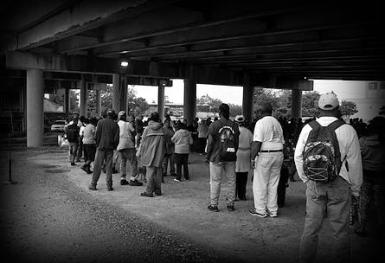
Walter: You know, when you’re homeless and you’re living in a tent time becomes almost less important.
Liz: What kind of things do you need to keep track of when you’re homeless?
Walter: Who’s feeding, and where. What time. Then a clock becomes very handy.
Liz: But otherwise there’s night and there’s day but time isn’t sliced out into hours and minutes.
Walter: For some people time is very crucial because they’re like, “I’ve got to get on the other side of town, I’ve got to put in this application, I want DSS or whoever to do something for me. I’ve got to get there on time.” Time, time, time.
Liz: I took the bus yesterday and got there a little early so I had to wait. There were a lot of people there waiting and I got to thinking about how much poverty is about waiting and about not having control over your time. How much time being poor takes. If you can afford a car you just walk out, get in your car and drive off.
Walter: You’re there in no time.
Liz: So is control over your time a luxury and lack of control a punishment? The ultimate punishment is prison, but when you get out of prison and you’re still living in poverty many of the things you want you’re going to have to wait for. To get a meal you’re going to have to stand in line, wait for the doors to open, wait for it to be your turn. So what does that say about time?
Walter: I’ll tell you one of the worst times that everybody says they’ve experienced, and I experienced, it’s your last day in prison. Your very last day. First of all, it’s already set–they have until midnight of your last day to let you out. You don’t know what time you’re getting out you just know you’re getting out within that twenty-four hour period. It seems like they wait and wait and wait until midnight to let you out. That is the longest day that anyone ever does in prison.
Liz: You know we’ve talked for an hour and I don’t think we’ve settled the question.
Walter: Maybe not, because to me this is one of those subjects that can go on for…..
Liz: …ever? Into eternity?
Walter: Into eternity, or what we call in Buddhism kuon-ganjo, time without ending, time without beginning, the never-ending circle.

 The Philosophers' Club