Session Three: But Is It Art?
Wednesday, October 1, 2014
The Philosophers’ Club took a break for a couple of weeks while Walter moved out of his tent and into his new place, a house a couple of miles south of downtown that he shares with two other veterans. When we finally got together again we met at a Wendy’s not too far from Walter’s new home. We sat in a booth, the music sifting quietly out of the overhead speakers and talked about art, a subject close to Walter’s identity and close to his heart.
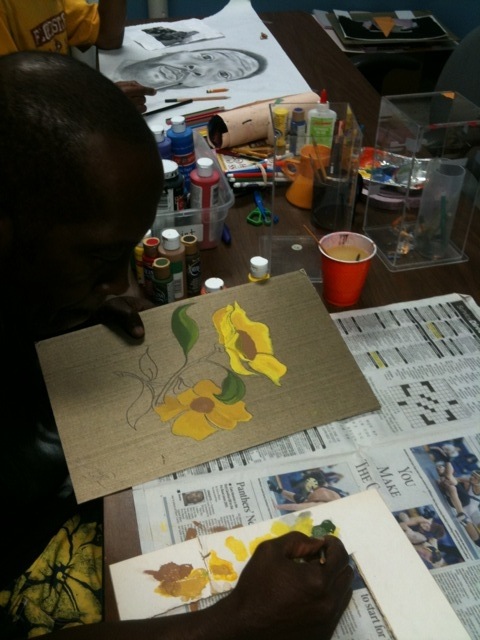
Walter painting.
What is the relationship between art and the world? The Ancients thought art was meant to copy the world as closely as possible, but in the era of modern art this can hardly be the case. Does art mirror the inner world of the artist or does it capture an archetype—a repeating pattern of life that can only be spelled out in particulars but refers to something much more general?
Liz: If both of us painted a rose and if we had the same artistic ability, which–speaking for myself–I’m not saying we do, but if we were at the same level of proficiency, our two roses would still come out different. Why is that?
Walter: Mainly because of the way each of us feels about the rose. I may look at the rose and say “Roses have thorns.” You may say “No, thorns have roses.”
Liz: So does that mean in some ways we’re always painting a self-portrait?
Walter: Pretty much.
Liz: So: ”What is the relationship between art and the world?”
Walter: The enjoyment of life.
Liz: “The Ancients thought art was meant to copy the world as closely as possible, but in the era of modern art this can hardly be the case.” You go to an art museum and you’ll see a lot of things that don’t look like a rose or like anything else you’ve ever seen before, but there’s something about them that’s really moving. Just stripes of color or blocks of wood. Is that art?
Walter: Oh, definitely. You know, I’ve drawn things or painted things and I thought it should be one thing but other people look at it and see something else. Whatever is in the eye of the beholder is what it is.
Liz: If it turns out a painting isn’t of anything would you still feel OK about it?
Walter: I think yes.
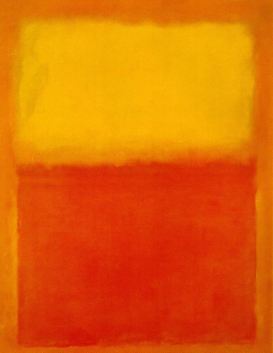 Liz: OK, here’s a painting by Mark Rothko. In real life it would be huge–at least I assume it would be because he painted large things.
Walter: Now you see that one I really don’t get the gist of. It could be a box or it could be maybe just a two-tone painting.
Liz: So here the question says “Does art mirror the inner world of the artist?”–like could it just be a painting of how he was feeling when he painted it? And it’s not there for people to look at and say “I think it’s a sunset on the desert.”
Walter: If a person asks me to do a painting of something my inspiration is not coming from me, from how I feel about that painting. It’s coming from my desire to please that person, to give that person satisfaction. But if I paint a picture that I just feel like painting, yes it’s a rendition of my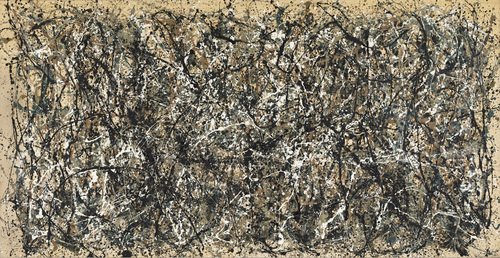 inner being.
Liz: Here’s a painting by Jackson Pollock.
Walter: Is that a bunch of people?
Liz: No, what he did was–the style of art is called Abstract Expressionism, and he’d take these great big canvases and put them on the ground and stand over them with pots of paint and drip. And he wasn’t trying to paint a picture of a train, or a snowstorm, he was just….So is that art?
Walter: Yeah, I’d have to say so. Like walking downtown looking at things, I might look at a wall and see a sculpture, or see a man standing, or a bird flying–it will be scratches on the wall or paint chips missing, but it will turn out to be art.
Liz: So you would still prefer that a painting correlate with something in the physical world.
Walter: For me, yes. Plus be a reflection of the inner me. I love it when nobody else can see it until I put it on canvas–I just love that.
Liz: Here’s another example, Picasso. He started with something you might recognize–I think it was a 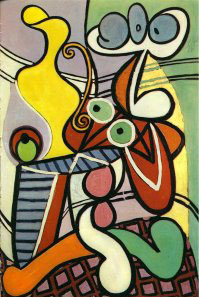 woman with a vase next to her–and then he altered it and reduced the shapes. In the beginning the only person who saw it that way was him, but now other people see it too. Which sort of gets to the last part of the question. “Does art mirror the inner world of the artist or does it capture an archetype—a repeating pattern of life that can only be spelled out in particulars but refers to something much more general….” is your art capturing the essence of the, say, fundamental, archetypal hummingbird? “….a repeating pattern of life that can only be spelled out in particulars but refers to something much more general?” You can only paint the hummingbird that you can paint, but deeply embedded in that is a reference to the perfect hummingbird.
Walter: I think I understand what you’re saying. Even though I put it on canvas it may not be the exact hummingbird I have in my mind. It’s a good one, but the one I had in mind may have been that much more perfect. I just can’t reach that peak. If it were left up to me and I could do it, the picture I would paint would be so real I could almost touch it. I guess we settle with good enough.
Liz: That’s sort of what I was saying, but not quite. But thinking of Mark Rothko or Jackson Pollock, those abstract painters, if you were trying to capture the emotion of, say, joy, one way to do it might be to paint a picture of somebody smiling. Another way might be to show something that gives you joy–flowers or hummingbirds or a fruit basket or something. But another way might be to feel joy until you can’t contain it anymore, then pick up a brush and just…..
Walter: I’d do a painting in bright colors, colors that stand out, that almost make sounds. You’re looking at a dark painting and all of a sudden there’s a bright yellow comes behind it, that kind of thing. There’s a red, a bright bright bright orange, something that would just pop out at you.
Liz: OK, I have no idea how to even come close to an answer to this next question, but say you created a total abstract painting and you knew that the bright circle in the middle was, say, your mother, but nobody else did. Still when people looked at the painting they felt something. What is that?
Walter: Now that’s hard to explain, but I do believe that it comes from the emotions that the artist felt at that moment. Take Kris Schumacher for instance, the eyes that she does. I asked her once what is this thing about eyes and she said “The eyes are the windows of the soul.” To her, to do an eye, it’s like she really is peering into a soul of a being.
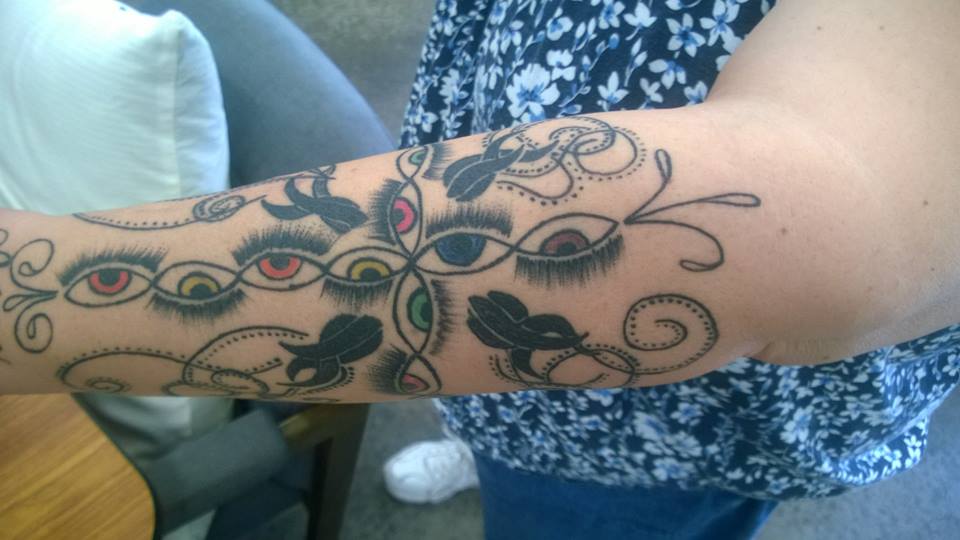
Tattoo based on one of Kris Schumacher’s designs.
Liz: And we’re attracted to her eyes not because they’re, like eyes in an optometrist’s textbook–we’re not saying “Now that’s a very accurate eye!”–but there’s just something about the eye.
Walter: Some of them look kind of morbid to me, nice but eerie, and other ones are just natural human eyes. They’re wonderful, but to her so much deeper.
Liz: Those Mark Rothko paintings, those paintings that had the big blocks of color–when I’ve seen one in person I’ve found myself really moved. I think sometimes what I’m responding to is just being forced to slow down and really look at the world, that what I’m looking at is the attention the artist put into the work.
Walter: I know. If I paint a bird nonchalantly in twenty minutes it will be one thing, but if I take that same bird and take two days to do it it will be that much better.
Liz: I have to say I’ve seen some work that people clearly put a lot of time into that I didn’t think was that good. It felt as though the artist was–what’s the word?–intellectually lazy. Instead of trying to find something unique and emotional about the subject, it was just all technique….
Walter: Sort of manufactured.
Liz: Yeah. It was like they weren’t willing to go there.
Walter: I think that can happen because of popularity. If an artist becomes so popular it’s lie “OK, it doesn’t matter what i put on paper as long as my name’s on it.” To me the wonderment of every painting is the key.
Liz: Here’s another Mark Rothko.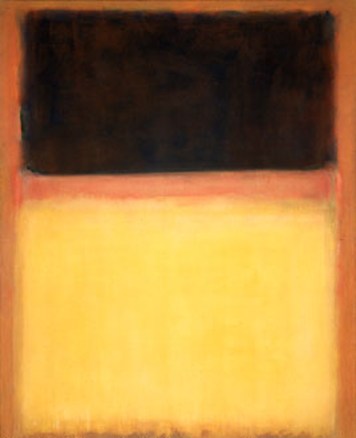
Walter: It almost looks like the same one flipped upside down,
Liz: He just kept exploring the same forms. It’s like if you dedicated yourself to painting nothing but hummingbirds somebody could say “This is just a bunch of birds”, but for you each one you would be posing a different question to yourself that you were trying to answer.
Walter: Hmm.
Liz: So here’s another artist. This particular painting is called “Nude Descending a Staircase”; what the artist is trying to capture is not just a moment but the whole sense of motion.
Walter: It looks like a bunch of junked up metal. I can’t really see the stairs.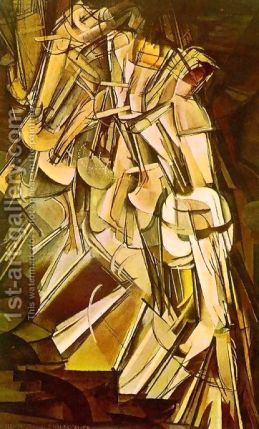
Liz: Can you see that there’s a person–that it’s almost like a movie?
Walter: Mmm.
Liz: So there are paintings that are trying to represent the world in a way that is not completely representational.
Walter: I know that isn’t just throwing paint on canvas on the floor. But as to that, I strongly believe that I can throw some paint on a canvas and then see something in it and turn it into something.
Liz: You just reminded me of something about my grandfather. He grew up in a Mennonite community that discouraged representational art but he became an artist anyway. One time when he was, I don’t know how old, old enough to be my grandfather, he was wearing boots with paint all on one side. I asked him how the paint got there and he told me he had been experimenting with a technique where he laid a board down and just squiggled paint on it, and then put another board on top and stomped on it–except once he slipped and fell and that’s how he got paint on his boots. He would do that and then he would take the two boards with the squiggled and squished paint and look at them until he saw something and then build from there. Kind of like what you’re
Walter: I think that’s a wonderful way to paint. You can’t call it cheating, it’s not tracing–it’s originality. I love it.
Liz: There’s a famous video of Jackson Pollock painting. Sometimes they’re called “action paintings” because what he was trying to capture was his own movements.
Walter: Like couch paintings, the ones that fit over your couch.
Liz: The ones people sell by the side of the road?
Walter: Yeah! There’ll be like a line going straight across the canvas and another line going straight across 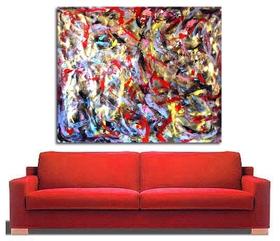 and sometimes it looks like a beam of light and other times it looks like an ocean wave coming in. Different colors.
Liz: You know that those paintings are done by assembly line, right? It’s somebody’s job to go down the line and do the squiggle, the squiggle, the squiggle, and the next guy will come along and do the line, the line, the line, like that. So is that art?
Walter: I’d be kind of questionable about that.
Liz: If it evokes an emotion in you but it doesn’t carry any of the emotion of the artist, is it art?
Walter: I think if it doesn’t carry any of the emotion of the artist it’s not art. I’m strongly an advocate of the artist putting his own emotions, his own feelings in a piece. Without the artist’s aspirations on canvas then to me it wouldn’t be art–not real art.
Liz: So to be real art I guess you have to have the artist’s intention, the artist’s skill…..
Walter: Somewhat.
Liz: ….and a receptive viewer?
Walter: Yeah. You know, I’m not so sure even if the skill is that important. I think the artist’s passion is more important than skill. If a person is passionate about doing art they’re going to do whatever they do well, whether someone else thinks it’s good or not.
Liz: I just found that video of Jackson Pollock here. Take a look.
Walter: Hmmm—squiggly line, squiggly line, dash, splash. Now that’s pretty interesting. Wow. Now you see it, that’s really turning out to be a….
Liz: I wonder if that’s kind of what you’re talking about. He’s all intention.
Walter: It’s all him. There’s no assembly line, no three or four people doing it, and he’s really filling the canvas up. It shows motion, it shows action.
Liz: I know I’m not supposed to be bossing The Philosophers’ Club around, but all I’m saying is don’t give up on Jackson Pollock.
Walter: Oh no. It already reminds me of when I was living in a tent in the woods.
Liz: Is it because it looks like the woods, or because it has a feeling?
Walter: It looks like the woods and it gives you that feeling.
Liz: Jackson Pollock had a lot of demons too. I think he painted the way he did partly because he was such a volcano inside. Which gets to another question that’s not part of our question here, but is it worth it for an artist to suffer, for an individual to suffer, if out of that suffering comes art that brings something to the rest of us?
Walter: Oh yeah. Depression, isolation–those are some of the more negative things that bring out artistic ability.
Liz: You’ve had hard things in your life. Have they contributed to your art? Would you be a different artist without them?
Walter: Would I be a different artist without them? Well, you know sometimes I think if I had been encouraged in my younger days to do art I would be that much better at it, but on the other hand if I hadn’t had that negativity in my life I wouldn’t spend so much time doing it now.
Liz: Is there anything in your art that that, I don’t know, expresses the fact that you’ve been incarcerated, for instance?
Walter: You mean, depicts that?
Liz: I don’t mean a picture of a window with bars on it, but using the emotions, the feelings of that experience.
Walter: In prison camp when you’re out in the yard all you can see is the yard with this wall encircling it. You can hear the cars, you can hear the birds outside, see the tops of the trees, the tops of the buildings, but you can’t see the people. All you can see is the sky. Being able to be out now and see all these things is a great inspiration. I want to capture these things so if I were to get into that tunnel vision again–which is never going to happen– I still have all these things with me. I know that this is what’s outside of those walls.
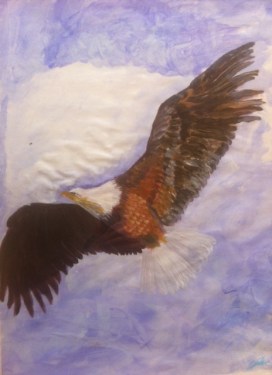
Eagle, Walter Jamison
Liz: I can see that. And that says something about you–it sounds as though what you draw on is gratitude for what you have now, where for somebody else the inspiration might be the anger at having been there then.
Walter: Yes.
Liz: So let me run through the question one last time: “Does art mirror the inner world of the artist or does it capture an archetype—a repeating pattern of life that can only be spelled out in particulars but refers to something much more general?”
Walter: The inner world of the artist.
Liz: That’s what I feel too. But as I look at it again–”Does art mirror the inner world of the artist or does it capture an archetype”–I think it can do both. What I’m reading in the question is that there could be a deep pattern in the world, you might call it God and I might call it something else, my own fuzzy, unformed spiritual life, and that the true artist is willing to go that deep, into that underground stream, to be part of that larger pattern of life. So do you think we should send this question back to Ben and say this is a false dichotomy?
Walter: I wouldn’t reject it–I would like to know what his opinion is. I’d like to know what he thinks of that question after he’s seen our answers.
BONUS TRACK! “I Die A Little”, inspired by Kris Schumacher and performed by haymarket RIOT.
 The Philosophers' Club