Session Two: Just Keep Checking In
Thursday, September 18, 2014
We met again at the library at Elsewhere. This time there were three of us: Walter, me and Walt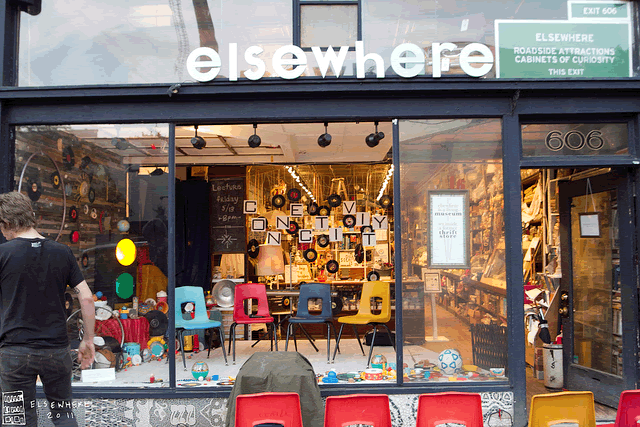 er’s friend Tammy, who sat in and contributed from life experiences that were different from both Walter’s and mine. After quick hellos we settled into an alcove filled with dictionaries and encyclopedias and jumped right into Ben’s second question.
Is meaning individual? People often use words—like freedom, good, or evil—without recognizing the terms themselves are open questions. With all of our varied life experiences, don’t we inevitably understand words through the lens of our past histories? If so, can any utterance mean the same thing for two people? Are we all trapped in our individual webs of meaning without hope for any pure communication?
Walter: If I use words like evil or good I just assume people know what I’m talking about.
Liz: So you think there’s something that everyone would recognize as evil?
Walter: Boy, that’s a tough one. Because everyone doesn’t think of evil in the same sense. Speaking on a personal basis I would say that evil would be for me some action that I might have taken, something I may have said, that injures somebody else and it bothers my conscience. To me that is an evil thing–for me. But somebody else might look at it and say “It wasn’t so bad, don’t worry about it.”
 Liz: So it sounds as though words do have individual meaning. If our lives–even the three of us sitting here have had very different lives–if our lives are so different, how can there be any hope of communicating? If evil for me means one thing, for you something else and for Tammy something else, when we’re talking to each other are we just talking at each other?
Walter: Agree to disagree?
Liz: But sometimes people don’t even know they’re disagreeing. If you say “I hate evil” and I say “I hate evil too!” but we’re talking about two different things….
Walter: I see what you’re saying. So a group of people, us three, we’d have to come to an agreement that we’re out to reach a certain goal.
Liz: Just among the three of us there’s the difference in gender, there’s the difference in race, the difference in age, the difference in where we grew up. Then there’s the difference in, well, just life experience.
Tammy: For me sexual abuse was about the roughest experience, that and my physical and mental abuse.
Liz: So when you approach the world that’s part of your toolkit. When somebody uses the word “love”, for instance it might mean something different to you than to Walter and me.
Tammy: I had to learn to love myself. That’s what I had to do.
Liz: Have you ever been to prison?
Tammy: No. I’ve been in jail but never to prison.
Liz: And Walter, you’ve been to prison….
Walter: Oh yeah.
Liz:…..and I never have. So if we were using the word “freedom”, for instance, it would mean something different to each of us.
Walter: You learn to value what’s out there a little bit more. You know, when I was in prison I met people who had life sentences and I met people who had natural life sentences, and I met people who were on death row.
Liz: What’s the difference between a life sentence and a natural life sentence?
Walter: A life sentence is, like, 25 years–you can get out in 25 years on post-release. Natural life is like there’s no parole ever, you’re just there, ward of the state. And you know what death row is. When I was in there the people on death row seemed to have a tighter grip on the meaning of life. You could really see how they would appreciate their freedom if they had it and how they would really appreciate and respect life. You would think they have nothing else to lose so they would feel free to do anything, but those people, the people I met that were actually on death row, they have such a grip, it’s like they have a pathway, a straight line to God. So, yes, “freedom”. There are different freedoms.
Liz: If we were sitting here without being conscious of trying to figure this out, if we were sitting here talking about freedom, what you might mean is….well, it sounds as though freedom is two things for you: physical freedom, but also freedom from…I don’t know, triviality? Is that what you were seeing in people on death row?
Walter: Those people, they had a kind of freedom. They were at peace.
Liz: Tammy, how long were you in jail?
Tammy: Of and on. Since I was 17. I had a lot of anger towards who had done those things to me, and sometimes towards other people too.
Walter: Sometimes Tammy and I clash because, you know, she grew up in a different environment. There was a lot of hatred, a lot of racism.
Tammy: Against interracial couples. Just because he’s black and I’m white. Now I don’t see anything  different, but we were all raised to be…if you dated a person of another race you could be killed for it. You could be killed for it and you deserved it.
Liz: So there’s another thing that was seen as evil at one time and now is not.
Walter: You know, that’s one subject that’s….oh boy. It’s calmed down a lot from when we were growing up but the sores, the pain, is there and remembered.
Liz: In your opinion is racism harmful to white people as well as black people?
Walter: My personal opinion, I think so. They grow up, they’re taught a certain thing. I don’t rightly blame the people who were brought up and raised that way, but….
Tammy: For me, even my cousin, my family didn’t know what I was going through. Walter didn’t know until I told him. I talk to him now.
Liz: Does talking help?
Tammy: Yes.
Liz: So that kind of goes back to language. I think part of what language is there for is to try to bring somebody else closer to actually experiencing what we/ve experienced. Just going back to the word 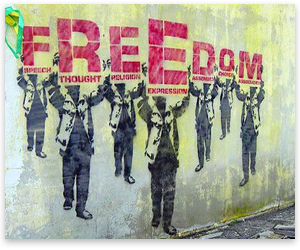 “freedom” for a moment–if I talk about freedom, my life has been very different from both of yours, I’ve never experienced the kind of abuse that you’ve survived, Tammy, and I’ve never experienced the racism that you’ve survived, Walter. I’ve never been to jail, I’ve never been to prison, I’ve never been homeless.
Tammy: I told Walter that I was going to learn from my daddy’s mistakes. My daddy spent nine years in prison. I said I’d rather learn from his mistakes than experience it myself.
Liz: What did he go to prison for?
Tammy: Attempted murder, larceny, arson.
Liz: Geez, that’s a lot to learn from.
Tammy: He got sentenced to 40 years and he got out on good behavior in nine years. Now I don’t know how to take him.
Liz: Was he changed when he came out?
Tammy: Somewhat yes, somewhat no. He adopted a new family and him and his new wife they wanted to raise her kids. Then they started abusing them and DSS came in and took them out, so I don’t see where he’s learned anything. Learned how to be more aggressive, more violent sometimes.
Liz: So freedom for you is freedom from all of that–not just not being in jail, but not having your life directed by…..
Tammy: By abuse.
Liz: In my case, because my life in some ways has been smaller than both of yours, because I haven’t walked on the wild side–or haven’t been dragged through the wild side–freedom for me is more like the freedom to create, freedom to express myself, freedom to play around with things and explore my own mind. That doesn’t mean that they’re all in separate boxes and freedom has to mean one thing or another, but if each of us said “I want to feel free”, what you might be saying is “I don’t want to be in prison” and what Tammy might be saying is “I don’t want to have to be afraid”, and what I might be saying is “I just want to write poetry.”
Walter: I think of a different kind of freedom that I’m actually fighting for now: freedom from homelessness. You know, I started out in the shelter and that was a kind of non-freedom because I was being dictated to by other people, being told when to go to bed, when to wake up, what to do during that day, wha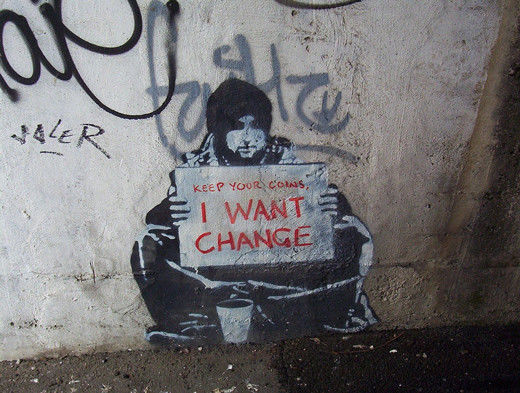 t to eat for breakfast. You don’t get a choice. I felt a kind of freedom when I moved out of there and down to a tent. Then I could make my own decisions, make my own choices, but what goes along with that is now I’m responsible for walking two or three miles to get something to eat or take a shower, stuff like that. Now I’m going for a new freedom, the freedom of having my own place–that would give me the freedom of not having to be cold in the winter, I can watch television all night long if I want to, go into the refrigerator and cook–not worry about what’s for dinner but decide on what I want for dinner.
Liz: So freedom of choice?
Walter: Freedom of choice. The people who already have that take it for granted. I think it’s different in different levels of life.
Tammy: A lot of times I cry about the things my family put me through.
Liz: So you want to be free to talk about it and not pretend it didn’t happen. So be free to be who you really are. That’s another kind of freedom.
Walter: The more we speak on it the more I realize there really are different kinds of freedom.
Liz: So is meaning individual? That’s the question. Is there any possibility of real communication? For you, for instance, Tammy, with your history of abuse, what someone else might think of as just a gesture you might see as a threat. Or what somebody might think of as a joke you might think of as an insult.
Tammy: Yes.
Liz: And then words are just one form of communication. There’s a poem by Robert Frost where he’s going out to mow, and as he’s going out he’s thinking about how all of us are alone. As he’s mowing, though, he sees that somebody else has come out earlier and been mowing nearby, and that that person had seen a tuft of flowers and had chosen not to mow them down.  At the end of the poem Robert Frost says that he realizes that we’re not alone, that in fact we’re all connected. That there are ways we communicate with each other even when we don’t set out to communicate with each other. So is there a deep common language that can transcend the experience of abuse or prison or whatever else?
Walter: What was the whole question again?
Liz: “Is meaning individual?”
Walter: Yes.
Liz: “People often use words—like freedom, good, or evil—without recognizing the terms themselves are open questions. With all of our varied life experiences, don’t we inevitably understand words through the lens of our past histories?”
Walter: That’s another yes.
Liz: “If so, can any utterance mean the same thing for two people? Are we all trapped in our individual webs of meaning without hope for any pure communication?”
Walter: I wouldn’t use the word trapped, because I would say that everyone is open to new things.
Tammy: I thought “trapped” meant bondage, bondage to your past.
Liz: Sort of.
Walter: Yes, sort of.
Liz: Trapped in our own web of interpretation.
Walter: That’s a form of self-enslavement.
Liz: You mean if we assume that our way is the only right way, and that other people’s experience, if it’s not like ours, doesn’t count, that would be self-enslavement?
Walter: Yes. Like I was telling Tammy about the bigotry, about the Klan and people who are racist, I kind of feel sorry for people who were taught that mentality and now they seem to be trapped in it.
Tammy: My grandpa was a Grand Dragon in the Ku Klux Klan.
Liz: So you’ve had to move a fair distance just to think for yourself. That seems like sort of the paradox in everything we’ve been talking about: true freedom is the freedom to think for yourself, but when you think for yourself communication may be more difficult. If everybody agrees that a color is blue and you think to yourself, no, it’s green, it’s harder to communicate with them because….
Walter: If the majority of people say it’s blue, you have no argument. You can know it’s green but what are you going to do?
Liz: But then you’re enslaved! If you know something isn’t true for you but you still go along with it–that’s denying yourself.
Walter: So the question is, are we stuck? I would say no. Unless we want to be.
Liz: Maybe we’re stuck as long as we don’t know we’re stuck.
Walter: OK, that’s the key right there, that’s it–being willing to check in with each other. Checking in. Just keep checking in.
 The Philosophers' Club
I’m deeply moved by the conversation and photos. I think you are on to something powerful here. Thank you for sharing.
LikeLike